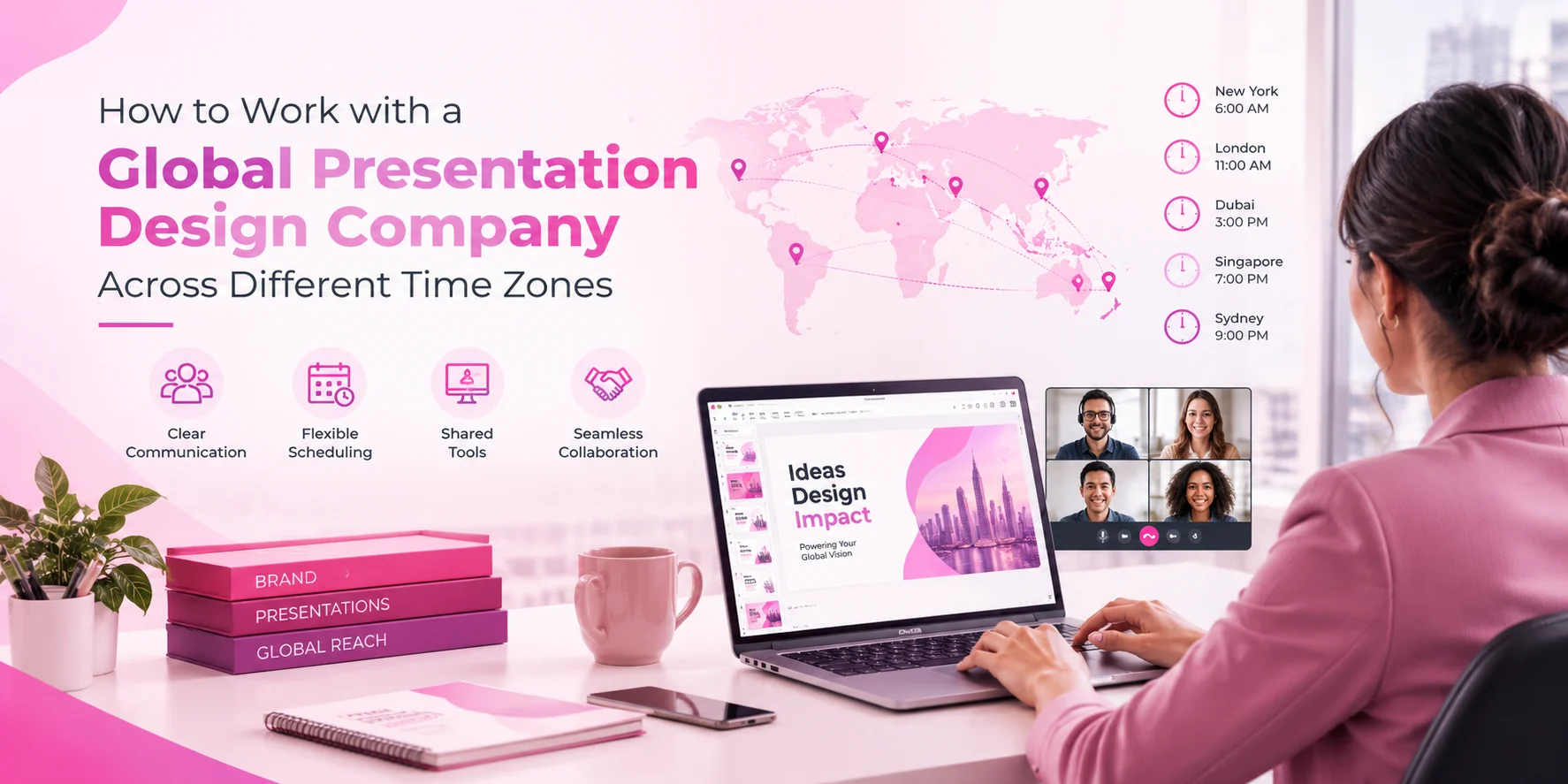
How to Work with a Global Presentation Design Company Across Different Time Zones
You have a deck due Friday, but your designer is asleep. Your feedback sits unread for ten hours. Sound familiar?
Working with a global presentation design company does not have to feel like that. With the right workflow, the time gap becomes an advantage instead of a delay. This guide shows how to brief, review and approve presentations across the USA, UK, Germany and India without missed deadlines or endless email chains.
Quick answer: To work with a global presentation design company across time zones, share a complete written brief, agree on a short overlap window, use one feedback channel and set dated approval milestones. Then use the overnight gap: send feedback at the end of your day and receive revised slides by morning.
Why Hire a Global Presentation Design Company?
Presentation needs do not follow one clock. A founder in California pitches investors on Monday. A sales team in London needs a product deck before Tuesday. A finance head in Frankfurt must finalize an annual report before the board meets. A global presentation design company serves all of them from one team with one quality standard.
Here is what you gain:
- Specialist skills: Designers who handle pitch decks, annual reports, sales presentations, product decks and webinar slides every week.
- Cost efficiency: SlideCEO’s typical pricing is around $200 to $250 for a 15 to 20 slide investor pitch deck with three rounds of revisions, and around $3 per page for annual reports. Final cost depends on complexity.
- Extended working hours: Work continues while your own team sleeps.
- Consistent branding: One team keeps your look aligned across regions.
Do Time Zones Really Slow Down Presentation Projects?
They can, but only when the process is vague. Delays rarely come from distance. They come from missing information, unclear feedback and unplanned waiting. The table shows the approximate gap between common client locations and India. Gaps shift by an hour when daylight saving changes, so always confirm meeting times in both zones.
| Your location | Approx. gap from India | Best live overlap |
|---|---|---|
| UK | 4.5 to 5.5 hours behind | Your morning to midday |
| Germany | 3.5 to 4.5 hours behind | Your morning to early afternoon |
| US East Coast | 9.5 to 10.5 hours behind | Your early morning |
| US West Coast | 12.5 to 13.5 hours behind | Your early morning, or async handoffs |
The pattern is clear. UK and German clients get easy live overlap. US clients get less live time but gain the most from overnight handoffs. The steps below help you use both.
7 Steps to Work Smoothly Across Time Zones
- Write a complete brief before kickoff
A strong brief prevents the slowest delay of all: waiting for answers. Include your audience, presentation goal, slide count, deadline, brand assets, reference decks and content status. Add the file formats you need, such as PowerPoint or PDF. A one-page brief can save a full day of back and forth.
- Agree on an overlap window and response times
Pick one or two hours when both teams are online, then use them for the kickoff and major decisions. Outside that window, agree on a reply time such as one business day. Everyone then knows what to expect.
- Use one central feedback channel
Scattered comments in email, chat and voice notes cause missed edits. Choose one place, such as a shared document or project board, and number every slide. Short screen recordings also help because they show exactly what you mean without a live call.
- Give feedback in consolidated batches
One complete list per round beats ten small messages. Most packages include limited revision rounds, so use them wisely: structure first, design second, final polish last. Be specific. Say “reduce the chart to three bars and enlarge the headline,” not “make it pop.”
- Use the overnight advantage
This is the biggest benefit of a global team. Send consolidated feedback at the end of your working day. By the time you start tomorrow, the revised slides are waiting. Two rounds can finish in two mornings instead of a week.
- Set milestone approvals with dates in both time zones
Break the project into four checkpoints: storyline approval, design direction on the first three slides, full draft, and final files. Write each deadline in both time zones to avoid confusion. Approving the storyline before design starts prevents costly rework on finished slides.
- Protect your files and confidentiality
Investor decks and annual reports contain sensitive data. Confirm that the agency offers confidentiality, signs an NDA when requested, and delivers editable source files with fonts included. Store everything in one shared folder with clear version names, such as Deck_V3_Final.
What Does a Time Zone Friendly Workflow Look Like?
Here is an illustrative five-day example for a US client working with an India-based team. Actual timelines depend on slide count and complexity.
- Day 1: Kickoff call and brief shared. Storyline outline starts overnight.
- Day 2: You approve the storyline in the morning. Design direction arrives by the next morning.
- Day 3: Full draft arrives. You send one consolidated feedback list at day’s end.
- Day 4: Revised deck is waiting when you log in. You send final tweaks.
- Day 5: Final PowerPoint and PDF files delivered.
How Do You Handle Regional Differences?
Global projects need local awareness. Check public holidays on both sides before setting deadlines, since Thanksgiving, Christmas and Diwali can all pause work. Confirm spelling style, such as US or UK English. Agree on date and number formats too. Germany writes 1.000,50 where the USA writes 1,000.50, and a mismatch in a financial chart looks careless. Finally, share local examples. Investor expectations in London differ from those in New York, and your designer should know which one you are targeting.
Which Tools Make Remote Collaboration Easier?
You do not need a complex stack. Four tool types cover most needs:
- Shared storage: Google Drive, OneDrive or SharePoint for files and version control.
- Messaging: Slack, Teams or WhatsApp for quick questions.
- Video feedback: Loom or similar screen recorders for visual comments.
- Scheduling: A world clock tool to find overlap hours fast.
What Mistakes Should You Avoid?
- Sending content in pieces after design starts.
- Giving vague feedback like “make it modern.”
- Skipping the brand guide or logo files.
- Waiting for live calls to make every decision.
- Forgetting holidays on either side.
- Starting the project days before an event.
What Should You Ask Before You Hire?
Use these questions to compare any presentation design agency:
- What are your overlap hours with my time zone?
- Who is my single point of contact?
- How many revision rounds are included?
- Which file formats and source files will I receive?
- Do you sign an NDA?
- Can you show work for my industry and region?
How Does SlideCEO Support Global Clients?
SlideCEO serves clients across the USA, Germany, the UK and India. Services cover investor pitch decks, annual reports, sales presentations, product presentations, event and webinar decks, marketing creatives and promotional videos. Typical packages include three rounds of free revisions, confidentiality, and delivery in formats like PowerPoint or PDF. Share your brief, and the team will map a workflow that fits your time zone.
Final Thoughts
Time zones are a planning issue, not a quality issue. A clear brief, one feedback channel, batched comments and dated milestones turn distance into speed. Choose a global presentation design company that works this way, and your next deck can be ready when you wake up.
Ready to start? Get a quote from SlideCEO and share your next presentation brief today.
FAQs
- How do you work with a presentation design company in a different time zone?
Share a detailed written brief, agree on one short overlap window, and use a single feedback channel. Send consolidated feedback at the end of your day so the team can revise overnight. Set approval milestones with dates in both time zones. - Can a global presentation design company deliver overnight?
Yes, in many cases. When you send feedback at the end of your day, an overseas team can work while you sleep and return revised slides by your morning. Delivery speed still depends on slide count and complexity. - How much does a global presentation design company charge?
Pricing depends on complexity and slide count. SlideCEO’s typical cost for a 15 to 20 slide investor pitch deck is around $200 to $250, including three rounds of free revisions. Annual reports typically cost around $3 per page. - How many revisions should I expect?
Ask before you sign. SlideCEO’s typical packages include three rounds of free revisions. To use them well, send structure feedback first, design feedback second and final polish last. - Do I need live calls to manage a remote design project?
Not for every step. One kickoff call is usually enough, plus a call for major decisions. Written briefs, numbered slide feedback and short screen recordings handle most other communication. - Is my presentation data safe with an overseas agency?
It can be, if the agency commits to confidentiality and signs an NDA. SlideCEO lists confidentiality as part of its pitch deck services. Always confirm this in writing before sharing financials or investor data. - What file formats will I receive?
Most agencies deliver editable PowerPoint files and PDFs. Confirm in your brief whether you also need source files, fonts, print versions or mobile-friendly versions. - Which time zone gap is hardest to manage?
The US West Coast has the largest gap with India, but it also benefits most from overnight handoffs. A clear process matters more than the size of the gap.